Specialty
Radiology / Imaging
India has a few radiologists for a very large number of scans, and a reporting day is spent as much on finding the patient a study belongs to as on reading it. The worklist is typed by hand at the console, and the report returns to a system that cannot match it to the order that asked for it.
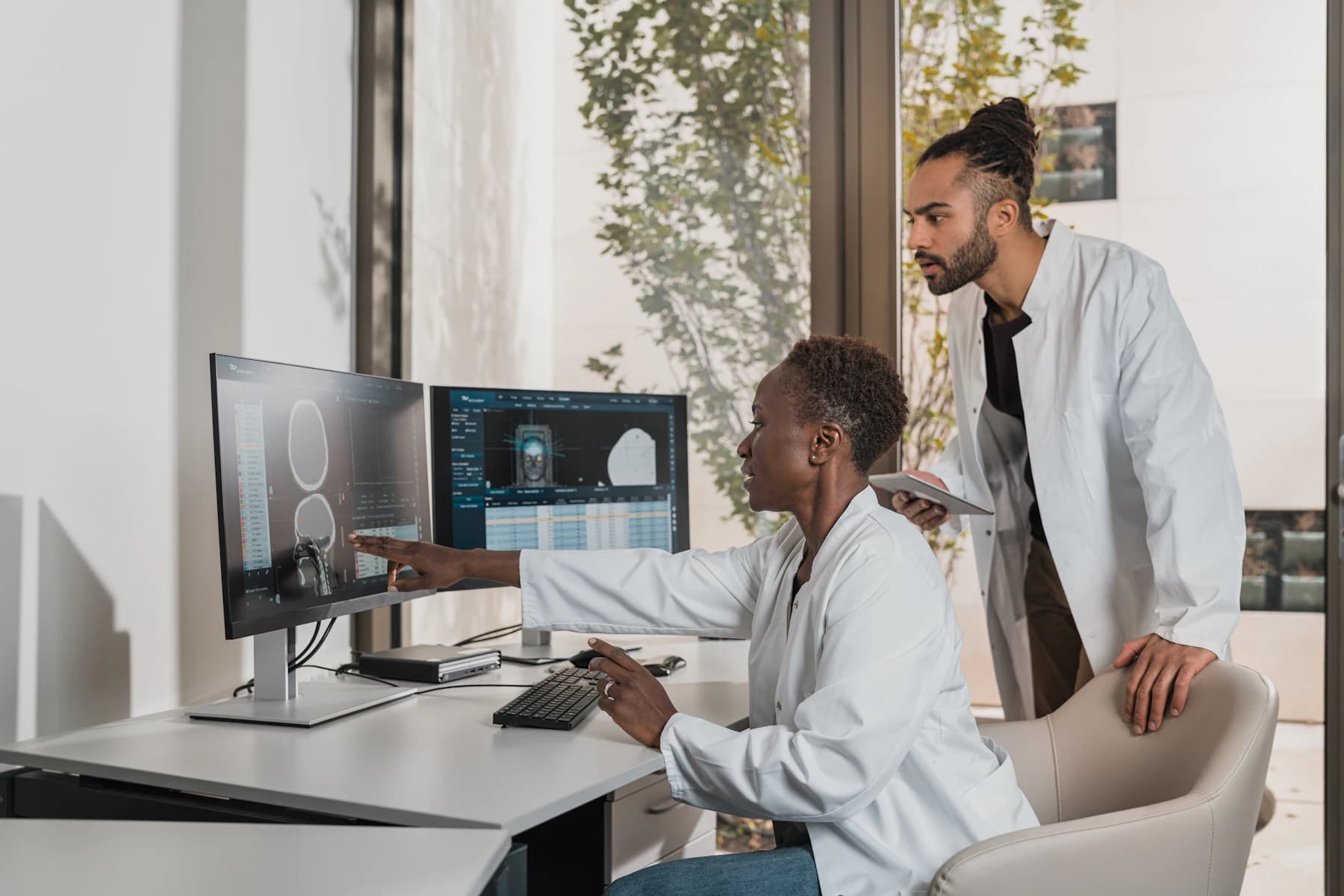
The reading room
The scarcest specialist in the country, reading studies that arrive without their question.
Impact and action
The worklist is typed at the console
- A technologist re-enters the patient’s name and number at the modality, and a keystroke there becomes a study no record will accept.Forge turns the order into the worklist entry the modality reads, and the completed study returns through the orophin bridge already matched to the order that created it.ForgeWestron
The study is in one system and the question is in another
- The image sits in a picture archive, the note that justified it sits in the file, and the reporting radiologist has one of the two open.Atlas holds the study beside the order and the note and opens it in the viewer under the same permission check as the rest of the record, with zoom, pan and measurement in the same window.Atlas
Reading capacity is in another city
- A scan acquired at night in a district hospital is read next morning by somebody four states away, over email and a file-sharing link nobody is auditing.Westron manages the connection and the credentials to the outside reader, translates the exchange into the format each side expects, and keeps a forensic trail of every file that left the hospital.Westron
Every prenatal scan carries a statutory declaration
- The PC&PNDT register is filled by hand beside the machine, and its completeness is discovered during an inspection rather than during the working week.Glyph attaches the declaration to the order as a locked form with formal sign-off, and Vigil keeps it with the evidence the hospital has to produce on demand.GlyphVigil
Turnaround is a figure assembled at month end
- Acquisition, reporting and release live in three systems, so the department manages the number it can produce rather than the delay patients feel.Falcon reads all three from the tools that own them, shows where each figure came from, and flags a number that has gone stale.Falcon
Where each stage of a study is held
One order, five stages. Four of them are a re-entry today.
| Stage | What moves | Held by |
|---|---|---|
| Request | The order, its priority and its clinical question | Forge |
| Acquisition | The worklist entry, and the study that comes back | Westron |
| Reading | The study, the order and the prior, in one window | Atlas |
| Report | The signed report, matched to the order that asked | Atlas |
| Measurement | The intervals between all four of the above | Falcon |
A report is finished when somebody has acted on it.
A study read and a study communicated are two events, and only one of them is usually measured.
The research on diagnostic error keeps arriving at the handover rather than at the reading: results that land in a queue belonging to nobody, follow up recommendations nobody schedules, and alerts addressed to several people and therefore to none of them.
Eliminate the abnormal result that lands on a screen with no owner. Sentinel raises it against a named person with an escalation chain, Raven delivers it on an approved channel with a delivery log, and Atlas keeps the record of who acknowledged it and when.
What an Indian imaging department adds
One reader, several machines, sometimes several sites.
- Studies are read wherever a reporter is free, and turnaround is known at the end of the month from a spreadsheet somebody maintains.Turnaround is read live out of the records the work already produced, with the source of every figure named on the screen it appears on.Falcon
- An outside reader is given a login that shows a great deal more than the study they were sent.Cirith decides every action against every record, and an administrator can list who holds access to one patient today and simulate a change before making it.
The worklist is typed twice.
- A technologist re-keys the patient and the study onto the modality console, and one typing error becomes a study filed against the wrong person.The order becomes the worklist entry, and the completed study returns to the order that created it.ForgeWestron
Form F, and the liability attached to it.
- Every prenatal ultrasound carries a statutory form whose absence is a criminal matter for the radiologist personally.The form is built by the department, locked on completion, versioned, and held with the study it belongs to.GlyphAtlas
The finding nobody asked for.
- An incidental finding with a follow up recommendation is a sentence in a report that nobody schedules.The recommendation becomes a due task with an owner and a date, on the record the report already sits in.Quest
Published research
What the literature measured, and who measured it.
These describe imaging departments that had never heard of Pensieve. They are cited to show the problem is measured, never to claim we have solved it for anyone.
- In an electronic record that raised an automated alert on an abnormal imaging result, 7.7 percent of alerts were never acknowledged and 4.0 percent of the abnormal results still lacked timely follow up four weeks later.Singh H, Thomas EJ, Mani S, et al. Timely follow-up of abnormal diagnostic imaging test results in an outpatient setting: are electronic medical records achieving their potential? Archives of Internal Medicine, 2009;169(17):1578-1586.
- Diagnostic error was estimated to affect about 5.08 percent of United States adults each year, approximately 12 million people, with about half of those errors carrying the potential for severe harm.Singh H, Meyer AND, Thomas EJ. The frequency of diagnostic errors in outpatient care: estimations from three large observational studies involving US adult populations. BMJ Quality and Safety, 2014;23(9):727-731.
- A review of radiological error puts the day to day discrepancy rate between reporting radiologists at 3 to 5 percent, and treats failure to communicate a finding as its own category of harm.Brady AP. Error and discrepancy in radiology: inevitable or avoidable? Insights into Imaging, 2017;8(1):171-182.
- A National Academies review concluded that most people will experience at least one diagnostic error in their lifetime, and named information that fails to reach the decision as a recurring contributor.National Academies of Sciences, Engineering, and Medicine. Improving Diagnosis in Health Care. Washington, DC: The National Academies Press, 2015.