Proven before it replaces anything.
A running model of your hospital, beside the one you run today.
Pensieve describes your hospital into the platform as a digital twin and connects it to the machines already running in it over one outbound link. The model produces the same answers on the same live data before a single workflow moves. Your hospital keeps running the entire time.
The idea
The platform runs beside the hospital before it runs anything in it
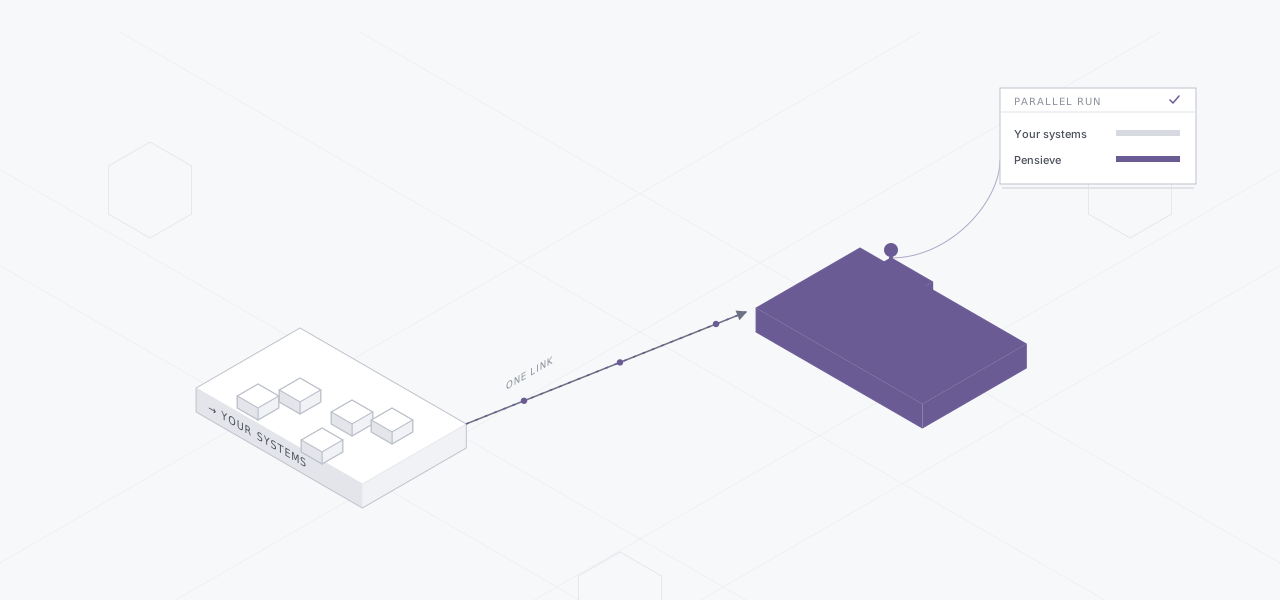
The first thing Pensieve does is run in parallel.
Deployment is additive. The systems you run today keep running: the platform connects to them on the interfaces they already expose, reads the traffic they already emit, and builds its model from that.
The parallel run is the proof.
Before a single workflow cuts over, Pensieve runs beside your live systems on the same day’s messages and produces its own answers. You compare the two on real traffic, in your own building, while the hospital works exactly as it did the week before.
Or it starts from paper.
Not every hospital has systems to run beside. Where a ward still keeps its record on paper, Pensieve becomes the first record it has, stood up at the pace the floor can take on.

The sequence
How a workflow goes live
Survey what you run today
A Pensieve engineer walks the floor with your IT lead and lists every system that holds or emits patient data: the HIS, the lab system, the analysers on the bench, the imaging archive, pharmacy, billing. Against each line the engineer records the interface it already exposes, and the same walk records the dates you already work to: the accreditation cycle, the payer and scheme deadlines, the financial year. Those dates order a cutover more often than any technical dependency. Nothing is installed in this step.
Connect over one outbound link
orophin, a single binary, is installed on one machine inside your network. It opens one outbound, mutually authenticated connection to Pensieve and opens nothing inward, so your network team approves an egress rule. Each system from the inventory is brought up as a connection in Westron and watched there. The adapters ship inside orophin; a connection is selected and pointed at your machine.
Read the existing record
History crosses on HL7 v2, FHIR R4, and DICOM, read over the same link that carries live traffic. Diagnoses are coded to ICD-11. Every write lands through the one governed database path, so a migrated record carries the same authorization and audit as one created today. Counts, codes, and patient identifiers are reconciled against the source before the history is treated as live.
Describe the hospital, then rehearse it
Your sites, wards, roles, tariffs, and forms are entered in Nexus Manager as the digital twin of the hospital. Cornea runs that model against a dummy site, where your clinical and operations leads walk an admission, an order, a discharge, and an invoice before a real patient is involved. This is configuration held as data, so a change takes effect the moment it is saved.
Run in parallel
The parallel run begins: for a chosen workflow, Pensieve produces its answer from the same feed your live system reads, and the two results are checked side by side over days of real traffic. A cutover plan and a rollback plan are written and approved before anything goes live.
First Light, then Hypercare
First Light is the cutover: one workflow goes live on real data, admissions or ordering or billing, whichever you choose first, with the rollback plan on standby and monitoring confirmed green. Everything else stays bridged and keeps running. Hypercare is the days after: your Pensieve engineer stays on the floor, reinforces your own super-users, and closes high-severity issues until the deployment is stable.
Every step waits on access and decisions inside your hospital. None waits on Pensieve writing code for you.
The parallel run
It reads what your systems already emit
Who does it
The engineers who write the platform sit with your hospital
A Forward Deployed Engineer owns your deployment from the first survey through go-live and into steady state.
The Forward Deployed Engineer is a Pensieve engineer drawn from the team that owns the code, so a defect found on your ward is reported by someone who can fix it. The work is translation: the engineer turns how your hospital actually runs into platform configuration held as data, and configures the platform to the hospital rather than writing bespoke software for it. A new department is another configuration change, live the moment it is saved.
Inside a boundary you can see and revoke.
The engineer holds no standing access to patient data: access is requested, approved by a second person, scoped to least privilege, time-bound, and written to your own audit trail. A read by an engineer passes through Cirith, the authorization model, checked and logged in the same transaction as anyone else’s. Clinical judgment stays with your clinicians; configuration encodes what they decide.
Support is engineering.
Diagnosis is free. When a fix is needed it lands on the one code line that every hospital shares. The purpose of a deployment is a hospital that runs Pensieve with the engineer out of the room.

Deployment models
Where the platform runs is your decision
The same Pensieve build runs in all four models. The choice sets your control posture; every capability is present in each.
The choice comes down to a few questions: whose computers the platform runs on, who owns the account, who holds the encryption keys, who is watching at 2 a.m., where the data physically sits, and how fast you go live.
What every model shares
The build is identical across the four. The integration boundary is the same single outbound link, and the export and deletion commitments do not change with the model.
You can change the model later
A hospital can move between models: from shared to dedicated, or from a Pensieve-hosted project into its own cloud account. The first decision sets where you start, and a later one can move you.
The four models, and what each decides
All four are real, fully supported products on the same platform.
| Model | Who runs it, who holds the keys | What it is for |
|---|---|---|
| DM-1 Dedicated | Pensieve runs it in a cloud project that is your hospital’s alone; Pensieve holds the account and the keys. | The default and the recommendation. The strongest isolation available without owning infrastructure, and the fastest to go live. It is the right choice unless a specific requirement rules it out. |
| DM-2 Shared | Pensieve runs it on shared infrastructure; separation is enforced in software, with keys and storage held per tenant. | Small clinics, single-speciality units, and price-sensitive deployments. Isolation is logical, not physical. |
| DM-3 Customer Cloud | Your hospital owns and pays for the cloud account; Pensieve operates inside it under a written, least-privilege grant. You hold the keys and can revoke access yourself. | Groups with a cloud team and a policy that they must own the account. For a single hospital it usually costs more than DM-1; what you gain is direct control of the account and the keys. |
| DM-4 On-Premise | The platform runs on hardware your hospital owns, in a room it controls. You hold the keys and the backups; Pensieve operates none of the infrastructure. | The strongest residency answer, and the slowest and most expensive. The availability commitment stops here, because Pensieve controls no hardware. |
Day counts, the per-model availability position, and the full comparison are published in the Trust Center.
Where the data sits
Residency answered in four parts
Where your data lives breaks into four parts, and the part that decides most compliance reviews is which countries a person can reach it from.
Residency has four parts: - Storage: where records, backups, and keys are held. - Processing: where the platform runs its computation. - Logs: where system and audit logs are written. - Human access: which countries a person can reach the data from.
Where each part sits depends on the model
In the hosted models Pensieve selects and holds the region. In Customer Cloud you select it inside your own account. On-premise, it is your own building, the strongest answer available. For Indian hospitals, all four parts stay inside India, in an Indian cloud region. Your hospital is the Data Fiduciary and Pensieve the Data Processor in every model, and Pensieve keeps no central copy of your data anywhere else.
Per market, in the Trust Center
The statutory analysis for each market, the configuration a hospital should verify, and the markets Pensieve cannot yet serve from its default infrastructure are published in the Trust Center. This page describes the shape of the answer; the legal detail lives there.
The exit
The way out is written beside the way in
A hospital should be able to read the exit before it commits to the entrance, and it stays visible the whole way through.
Your data is yours: all of it, at any time, in a form you can use, however the relationship ends, including if it ends over an unpaid invoice. The commitment is contractual. Pensieve waives any lien or right of retention over customer data, and it never charges you for giving you your data.
In a form a successor can load
The export carries structured data, clinical records in standard healthcare formats, imaging, documents, configuration, audit logs, a data dictionary, and integrity hashes. The data dictionary maps every field and the integrity hashes let a competent successor vendor load and verify it without further help from Pensieve.
The same machinery runs backwards
The record leaves on the standards it arrived on: HL7 v2, FHIR R4, DICOM, coded to ICD-11. The connections in Westron are configuration, so undoing them is configuration, and orophin is one binary your IT team uninstalls. On termination Pensieve deletes production and non-production data and destroys the keys, closed by a countersigned certificate of deletion. In Customer Cloud and on-premise the data already sits in your account or on your hardware, so Pensieve ceasing to exist cannot move it or switch it off. The export format, the deletion window, and the escrow terms are in the Trust Center.
Timing
Where the schedule comes from
A delivery clock and a commercial clock run from the first week. The delivery clock covers the work on this page, survey to cutover. The commercial clock covers approvals, the security review, contracting, and payment. The fee that commissions the work settles up front, so the money question is closed before go-live.
Go-live is a configuration exercise on one immutable platform, which is why the hosted models are measured in days, Customer Cloud in weeks, and on-premise in months. Those are the shape of the work. A dated plan for your own facility, with a named owner on each side of every step, is issued once the platform is connected and the parallel run is reading live data.
What the hospital must supply on its own floor, the endpoints, network, power, and connectivity for the first wave, is listed in the proposal before you accept it. Your own procurement then runs in parallel and never sets the go-live date. Where there is a gap, a short-term rental keeps your purchase cycle off the critical path.
Pensieve prints no day count on this page, because a number here would be a guess about your institution. The counts, the tracks, and the availability position are published where they bind someone, in the Trust Center. How a hospital starts covers the commercial clock.