Department
Lab / Pathology
Almost nothing that goes wrong in a laboratory goes wrong at the analyser. It goes wrong where a sample is labelled, where a request is typed a second time, and where a validated result waits for somebody to notice it.
Chain of custody
Order to report, as one object.
The order
A clinician orders from the hospital approved test catalogue. The order carries the patient, the visit, the clinical indication and the priority, and it is the only request the laboratory will ever see.
The sample
The order becomes a collection task and then a sample, labelled against the same object. The container, the tube type and the collection time are recorded at the point of collection.
The bench
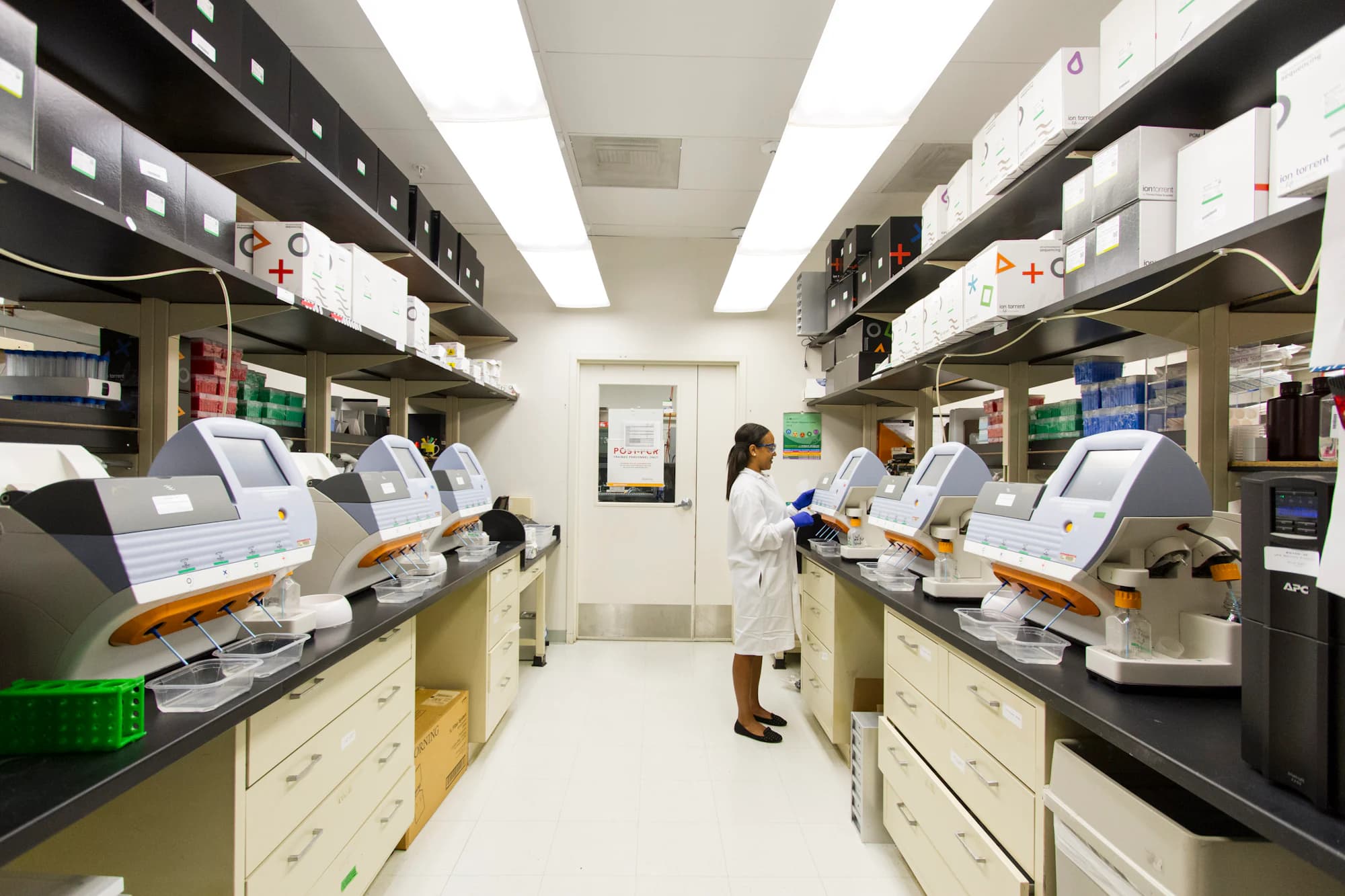
The analyser receives the work, and its output is bridged back and matched to the order that produced it. There is no second request to key in.
Validation
A pathologist or a technologist validates the result against the order. The validation is a named action with a timestamp, and it is what releases the report.
The report
The validated result lands on the record it was ordered from, is visible to the person who ordered it, and a critical value raises an owned alert instead of waiting to be seen.
Every step above already happens. What changes is that all five are states of one object rather than five entries in five systems.
Impact and action
The request is typed twice.
- The clinician writes a request, the laboratory types it into its own system, and the two disagree about which tests were actually asked for.Forge places the order once, and the laboratory works the order rather than a transcription of it.Forge
- Results are matched back to patients by hand, and a report reaches the wrong file often enough that everybody has a story about it.The orophin bridge carries analyser output back over ASTM and HL7 v2 and matches it to the order that produced it, so the result cannot arrive unattached.Westron
The critical value sits on a screen.
- A potassium of seven is validated at midnight and telephoned to a ward where the phone rings out. The call is recorded in a diary, if at all.Sentinel raises an owned alert with an escalation chain, hands delivery to Raven, and records whether it was seen, acknowledged and resolved.SentinelRaven
- Turnaround time is quoted from memory and disputed by every department that waits on it.Falcon reports turnaround by stage, so the delay is attributable to collection, transport, the bench or validation rather than to the laboratory in general.Falcon
The sample is the weakest link.
- Wrong tube, wrong label, haemolysed sample, and a repeat collection nobody counts. The rejection is communicated by telephone and forgotten.Rejection is a state of the order, so the ward sees it, the recollection is a task with an owner, and the rejection rate becomes a measure the laboratory can act on.QuestFalcon
- Internal quality control and instrument calibration live in a bench register that only exists on paper.Glyph carries the quality control and calibration records as structured, locked forms, and Vigil reads them as accreditation evidence.GlyphVigil
The tools this department lives in.
Read top to bottom. Each tag is a tool inside Pensieve, and the line beside it is what that tool does in a laboratory specifically.
| Tool | What it does in this department |
|---|---|
| Forge | The test order from the approved catalogue, its sample, its state, and its route to an outside laboratory when needed. |
| Westron | The connections to analysers and to outside laboratories: credentials, ASTM and HL7 v2 translation, traffic health, forensic trail. |
| Atlas | The record the validated result lands on, beside the note that ordered it and under one permission check. |
| Sentinel | Critical value rules defined by the laboratory, raised as owned alerts with an escalation chain and a resolution state. |
| Glyph | The reporting form, internal quality control records, calibration logs and the histopathology report itself. |
| Quest | Collection rounds, recollections after a rejection, and timed sample handling as due tasks against the roster. |
| Vault | The charge raised when the test is ordered, at the catalogue price of that day, including outsourced tests. |
| Falcon | Turnaround by stage, rejection rate by ward and by tube type, workload by bench, and outsourcing spend. |
| Vigil | The accreditation evidence file: competency records, internal audits, equipment maintenance and quality control. |
Published research
What the literature already measured.
Findings about laboratory work, each with its study and a link. None of it is a Pensieve result.
- In a prospective study of errors in a hospital stat laboratory, 68.2 percent arose before the sample reached the analyser and a further 18.5 percent after the result left it.Plebani M, Carraro P. Clinical Chemistry, 1997. The dominant categories were identification, container and reporting against the wrong request.
- A National Academies review concluded that most people will experience at least one diagnostic error in their lifetime, and named information that fails to reach the decision as a recurring contributor.National Academies of Sciences, Engineering, and Medicine. Improving Diagnosis in Health Care, 2015.
- Under a state mandate that put emergency sepsis care on one clock, each additional hour taken to complete the three-hour bundle carried higher risk-adjusted in-hospital mortality.Seymour CW, Gesten F, Prescott HC, et al. New England Journal of Medicine, 2017. Blood cultures and a serum lactate are two of the three items.
Everyone is waiting on this department.
The casualty
A time critical bundle contains a lactate and a blood culture. The clock the emergency department is measured on runs through the laboratory, so the state of the order is visible in the bay.
Intensive care
Blood gases and cultures are ordered continuously and read urgently. A critical value becomes an alert with an owner rather than a number on an unwatched screen.
The blood bank
Group, screen and crossmatch are laboratory work with a transfusion consequence, and they belong to the same visit as the issue record.
The insurance desk
A cashless authorisation needs the investigation report inside a working hour. The report is already attached to the visit the claim is built from.
Governance
The department whose errors happen outside it.
A laboratory’s quality system covers the analyser. The published error distribution does not: in a prospective study of a hospital stat laboratory, 68.2 percent of errors arose before the sample reached the analyser and a further 18.5 percent after the result left it. Source 12 Delete the assumption that a laboratory’s risk sits inside the laboratory. The order, the sample, the analyser result and the validated report are one object on one record, which is where the two ends of that distribution actually live.
The connection to the analyser is governed.
Westron is the console for every connection the laboratory depends on: the analysers, the outside laboratory a test is sent to, the referring clinic. It holds the credentials, translates between the hospital’s format and the outside system’s, watches incoming traffic for problems, and keeps a forensic trail of every exchange. The orophin bridge on site opens one outbound connection and asks for no inbound firewall hole.
Accreditation is separate, and it is counted.
Medical laboratories in India are accredited separately from the hospital around them, and the national board publishes the count. Source 30 Vigil keeps the internal audits, the competency records, the equipment calibration and the corrective actions standing rather than assembled before an assessment.
A result belongs to the patient as well as the hospital.
Cirith decides per action who may open a result, and it treats consent together with admission as the gate. A referring clinician outside the hospital reads through a governed path rather than through a forwarded file.
Federation and supply
When the sample leaves the building.
- The outside laboratory.Tests routed to a reference laboratory travel as the same order object, and the result comes back matched to it. The referral, the turnaround and the cost are visible on the order rather than reconciled from an invoice at month end.
- Several sites, one catalogue.A group running laboratories at several units keeps one test catalogue, one reference range set and one governance model across them, while each unit keeps its own accreditation file.
- Reagents and consumables.Pensieve integrates with the inventory system a hospital already runs. Where there is none, the app is built in [Durin](/tools/durin), either by hospital staff with no code and no vendor ticket, or by a Pensieve forward-deployed engineer who builds it for the hospital and hands it over. Anything built that way sits on the same permissions and the same audit trail as the rest of the platform.