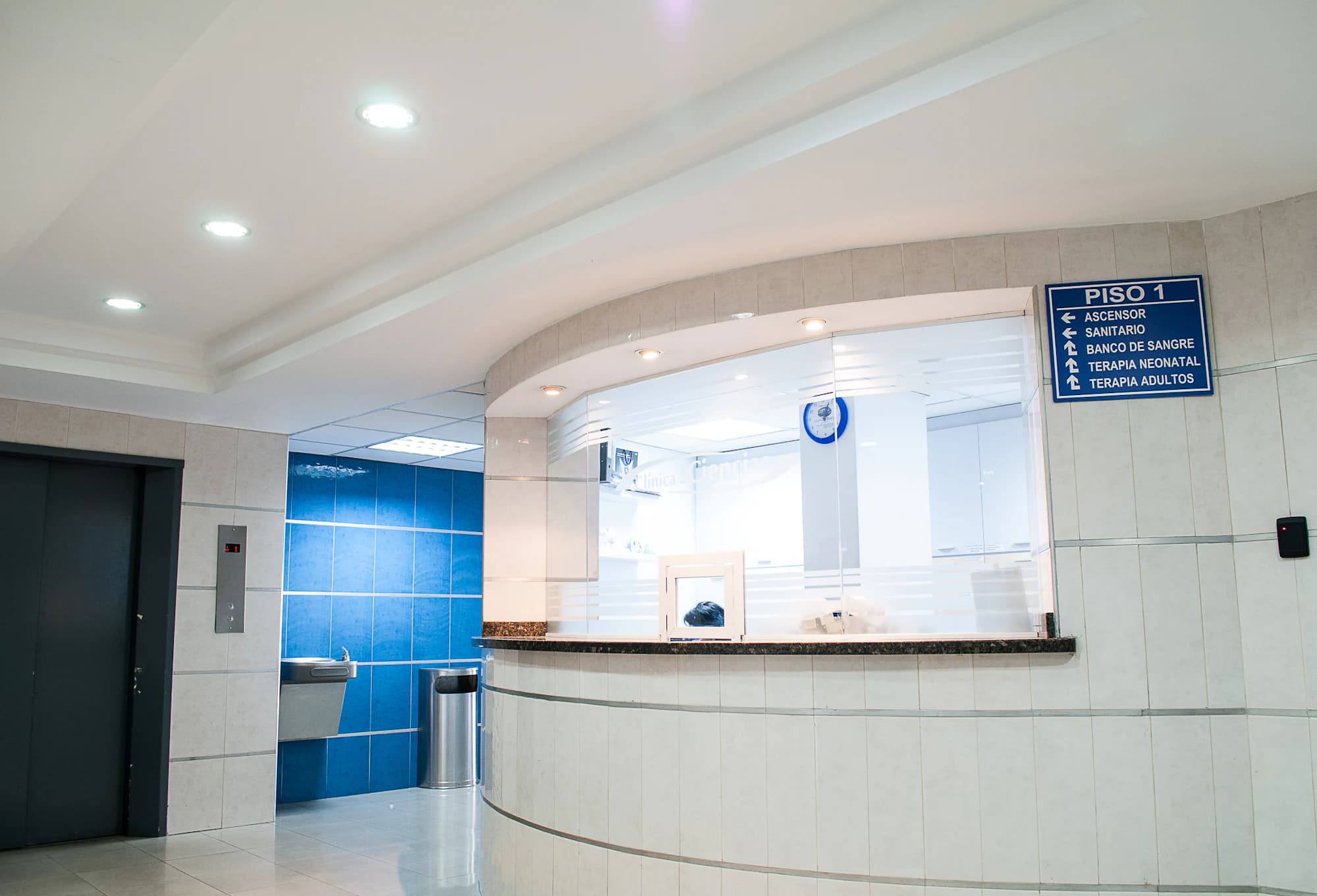
Department
OPD / Outpatient
An outpatient department is judged on one number the hospital rarely owns: how long a patient stands still. Most of that waiting is spent inside the department, in front of a counter that is holding out for a record, a token, a payment or a report the building already has.
The department that meets the city.
Every other department receives a patient who has already been identified. The OPD is where the identity is made, and everything downstream inherits whatever is made here.
A morning list in an Indian OPD is assembled out of three separate populations at once: appointments booked days ago, walk-ins who arrived at six, and follow-ups carrying a paper file from a visit the hospital can no longer find. The department is asked to serve all three from one counter, price them under three different payer arrangements, and hand each of them to a consulting room that has no idea which of the three is standing in the doorway.
The result is a queue that looks like a staffing problem and is really a record problem. Time is lost re-establishing facts the hospital already holds.
Impact and action
The queue is made of re-typing.
- Registration, tokening, the consult and the cash counter each open their own screen and ask for the same details again. A walk-in is registered twice because the second clerk cannot see the first entry until it is saved.Gate opens one visit at the counter, and the token, the consulting room, every order and the bill hang off that visit rather than off a fresh form.Gate
- The consultation is spent reconstructing a history from a thin printout and whatever the patient brought in a plastic folder.Atlas loads the whole record as one timeline, so the visit begins with the previous visit instead of with a blank page.Atlas
Two files for one person.
- A patient is registered as Ramesh Kumar in March and R. Kumar in September, and the two histories never meet. The duplicate is found at the billing counter, or during a scheme audit, or never.Registration resolves against the identities the hospital already holds before it creates a new one, and every tool afterwards reads that single identity rather than keeping a copy.GateAtlas
- Government scheme and insurance identifiers are captured on a separate register, so the same person carries one number in the clinical record and another in the claim.Scheme and payer identifiers attach to the patient rather than to the claim, and Vault prices the visit against the arrangement that identity carries.Vault
The order leaves the room and stops.
- A prescription is written on a pad, a lab slip is written on another, and the patient carries both to counters that will type them in again. Charges captured at the desk never reach the bill.Forge places the drug, the test, the scan and the referral as one order, which arrives at the pharmacy, the laboratory and the billing desk as the same object.ForgeVault
- Appointment reminders go out from a staff member's own phone, so there is no delivery record and no consent trail behind them.Raven sends confirmations and reminders on hospital approved templates over an audited channel, and logs sent, delivered, failed and read.Raven
The visit
Arrival to bill, as one object.
Identity, once
The counter resolves an existing patient or creates one. The visit opens against that identity, with the payer arrangement and the scheme eligibility attached to it.
Token and room
The token is a property of the visit rather than a separate book, so the consulting room sees who is waiting and why, and the department sees where the morning is running late.
The consult
Atlas holds the history, Glyph carries the department's own consultation form, and Forge places everything the clinician orders in one action.
Fulfilment
The pharmacy, the laboratory and imaging receive the order itself. Nothing is re-keyed, and the state of every order is visible from the consulting room.
The bill
Vault has been adding each chargeable order as it was placed, so the counter is settling a bill rather than assembling one.
Registration to settlement is one lifecycle. A department that runs it as five systems is doing reconciliation work five times.
The tools this department lives in.
A vertical roster, read top to bottom. Each tag is a tool inside Pensieve, and the line beside it is what that tool does in an outpatient department specifically.
| Tool | What it does in this department |
|---|---|
| Gate | Registration, appointments, the token, and the visit lifecycle itself. This is where the one shared identity is created. |
| Atlas | The consulting room view: history, previous notes, uploaded reports and prior scans as one timeline, under one permission check. |
| Forge | Drugs, laboratory tests, imaging, procedures and referrals placed as one order from the hospital approved catalogue. |
| Glyph | The department's own consultation form, consent forms with a formal sign-off, and calculators the OPD actually uses. |
| Vault | Consultation fees, package pricing, scheme and payer rules, and a charge added the moment a chargeable order is placed. |
| Raven | Appointment confirmations, reminders and report-ready messages on approved templates, with a delivery log per message. |
| Falcon | Where the morning is losing time: waiting by stage, no-show rate by clinic, revenue by consultant and by payer. |
| Quest | Follow-up recalls and review dates as due tasks against the roster, rather than a diary entry somebody has to remember. |
Published research
What the literature already measured.
None of this is a Pensieve result. Each line is a published finding about how outpatient work behaves, with the study and a link to read it.
- Across four specialties, physicians spent 49.2 percent of the office day on the record and desk work, and 27.0 percent in direct time with patients.Sinsky C, Colligan L, Li L, et al. Allocation of Physician Time in Ambulatory Practice. Annals of Internal Medicine, 2016.
- India's national auditor found 749,820 scheme beneficiaries registered against one mobile number, and 78,396 instances of a single patient recorded as admitted to more than one hospital at the same time.Comptroller and Auditor General of India, Report No. 11 of 2023, Performance Audit of Ayushman Bharat PM-JAY. The finding is about identity, which is what an outpatient counter creates.
- In the trial that established computerised order entry, serious medication errors that reached the patient fell by 55 percent.Bates DW, Leape LL, Cullen DJ, et al. JAMA, 1998. The mechanism was ordering from a structured catalogue rather than writing free text on a pad.
Where the OPD meets the rest of the hospital.
The pharmacy
A prescription that arrives as paper has to be read, interpreted and typed. Forge delivers the order itself, so the pharmacy dispenses against what was prescribed and the charge is already on the bill.
The laboratory and imaging
An outpatient test ordered on a slip becomes a requisition somebody types, a sample somebody labels and a report somebody carries back. The order travels instead, and the result lands on the record it was ordered from.
The wards
An OPD patient who is admitted arrives in the ward with the identity, the history and the open orders already attached, so the ward inherits a record rather than starting one.
The insurance desk
A cashless outpatient procedure needs a document pack assembled inside a working hour. The pack is built from the visit rather than photocopied from it.
Compliance
What the counter is legally doing.
Registration is the point at which an Indian hospital takes on most of its data obligations, and the counter is where nearly all of them start.
- ABHA creation and linkage are offered at the counter and remain voluntary. A patient who declines is registered and treated exactly as before, because a national identifier can never be a condition of care.
- Consent is captured as a signed artefact through Glyph, versioned, and readable later against the exact form that was signed.
The hospital holds the record and decides who may open it. Pensieve is the instrument that enforces the decision.
Stop treating registration as paperwork that precedes the visit. It is the visit, and everything the hospital does that day is an inheritance from it.
Governance
The clinic with the most readers and the shortest visits.
Outpatients is where the largest number of people touch the largest number of records for the smallest amount of time each. That combination is what makes access here a standing question rather than a settled one, and it is the hospital that answers it.
Consent and admission are one gate.
Cirith treats the patient’s consent together with the hospital’s admission as the gate that unlocks a record, and it decides per action whether a specific person may take it. A registrar covering a clinic for one afternoon holds the access that afternoon needs and holds it for that afternoon.
The emergency path exists, and it is loud.
There is an access path for urgent cases where the ordinary gate would delay care. Every use of it is logged, attributable and reviewable, which is what makes it safe to have.
The record travels in a form other software can read.
Export speaks HL7 v2, FHIR R4 and DICOM. A hospital that decides to leave takes the outpatient record with it, and a hospital that runs several sites keeps one master patient index across them rather than one per unit.
Compliance
What an Indian outpatient department is answerable for.
Compliance is a property of how the hospital works. What software can do is hold the record and produce the evidence a review asks to see, without a scramble in the six weeks before it.
- Digital records and linkage.The hospital registers on the facility registry, links records at the point of care, and shares in a consent-based standard format. Linkage stays voluntary for the patient. [Source 25](/research#ref-digital-incentive)
- Consent, notice and erasure.Purpose-limited consent at the point of registration, standardised across every touchpoint, with breach duties and erasure rights that collide with statutory retention. Consent is held on the record, and every tool reads it from there.
- The clinical record itself.Every entry carries author, timestamp, department and signature. Accreditation standards ask for record integrity and confidentiality as evidence, and Vigil keeps that evidence standing.